
Editorial status: Awaiting verificationDrafted from the cited sources; not yet fully reviewed by the editors.
Contents (8)
In this chapter
- Reçak
- Rambouillet and Paris
- NATO's air campaign
- Expulsions and refugee routes
- Crimes examined by the ICTY
- Kumanovo, 1244 and KFOR
Key dates
- The Reçak massacre
- Talks open at Rambouillet
- The Albanian delegation signs the agreement in Paris
- NATO's air campaign begins
- Killing of members of the Berisha family in Suharekë
- The ICTY makes public its indictment of Slobodan Milošević
- The Kumanovo Agreement
- Resolution 1244; bombing suspended
- KFOR enters Kosovo
- Withdrawal of Serbian and Yugoslav forces completed
Reçak, 15 January 1999
On 15 January 1999, Serbian police forces carried out an operation in the village of Reçak in Shtime municipality. The next day, OSCE verifiers led by William Walker found the bodies of the dead, many of them in a gully near the village. The Verification Mission reported 45 people killed and, together with Human Rights Watch, described the killings as executions of civilians.[1][2]
The Yugoslav authorities rejected this account, claiming that the dead were KLA members killed in combat and that the scene had been staged. A team of Finnish forensic experts engaged by the European Union examined at least 40 bodies; its conclusions and the way they were made public became a subject of debate. Reçak was included in the ICTY indictment of Slobodan Milošević, but the trial ended with his death in 2006, without a judgment. The sources and the disagreements are set out in detail in the analysis of Reçak.[3][4]
Rambouillet and Paris
Under pressure from the Contact Group, the delegations met at the château of Rambouillet near Paris from 6 to 23 February 1999. The Albanian delegation included representatives of the KLA, the LDK and other parties, as well as independent figures — among them Ibrahim Rugova and Veton Surroi — and was led by Hashim Thaçi. The draft agreement provided for broad autonomy, an international civilian presence, a NATO-led military force and a mechanism for a final settlement after three years.[5][6][4]
When the talks resumed in Paris, the Albanian delegation signed the agreement on 18 March 1999, while the delegation of the Federal Republic of Yugoslavia and Serbia refused. Scholars still debate whether the terms of the military annex — which gave the NATO-led force freedom of movement throughout FRY territory — made the agreement unacceptable to Belgrade, or whether the refusal had deeper political reasons.[5][7][8]
NATO's intervention
On 20 March 1999 the OSCE verifiers withdrew from Kosovo. On 24 March NATO began an air campaign against targets in the Federal Republic of Yugoslavia that lasted until 10 June. The intervention took place without explicit Security Council authorization, prompting a long legal and political debate over its legality and legitimacy.[9][7][8]
The bombing also caused civilian casualties, among them Kosovo Albanians, Serbs and others; Human Rights Watch documented the incidents in a report published in 2000. A committee established by the ICTY Prosecutor reviewed the campaign and recommended that no investigation be opened. The debate is presented in the analysis of the intervention's legality.[10][11]
Mass expulsions and the crimes of 1999
As soon as the bombing began, forces of Serbia's Ministry of Internal Affairs and Yugoslav Army units — in some cases accompanied by paramilitary groups — launched a systematic campaign to expel Albanians. In Šainović et al., the ICTY established in a final judgment the existence of a joint criminal enterprise whose purpose was to maintain control over Kosovo by altering its ethnic balance through deportation and other crimes.[12][13]
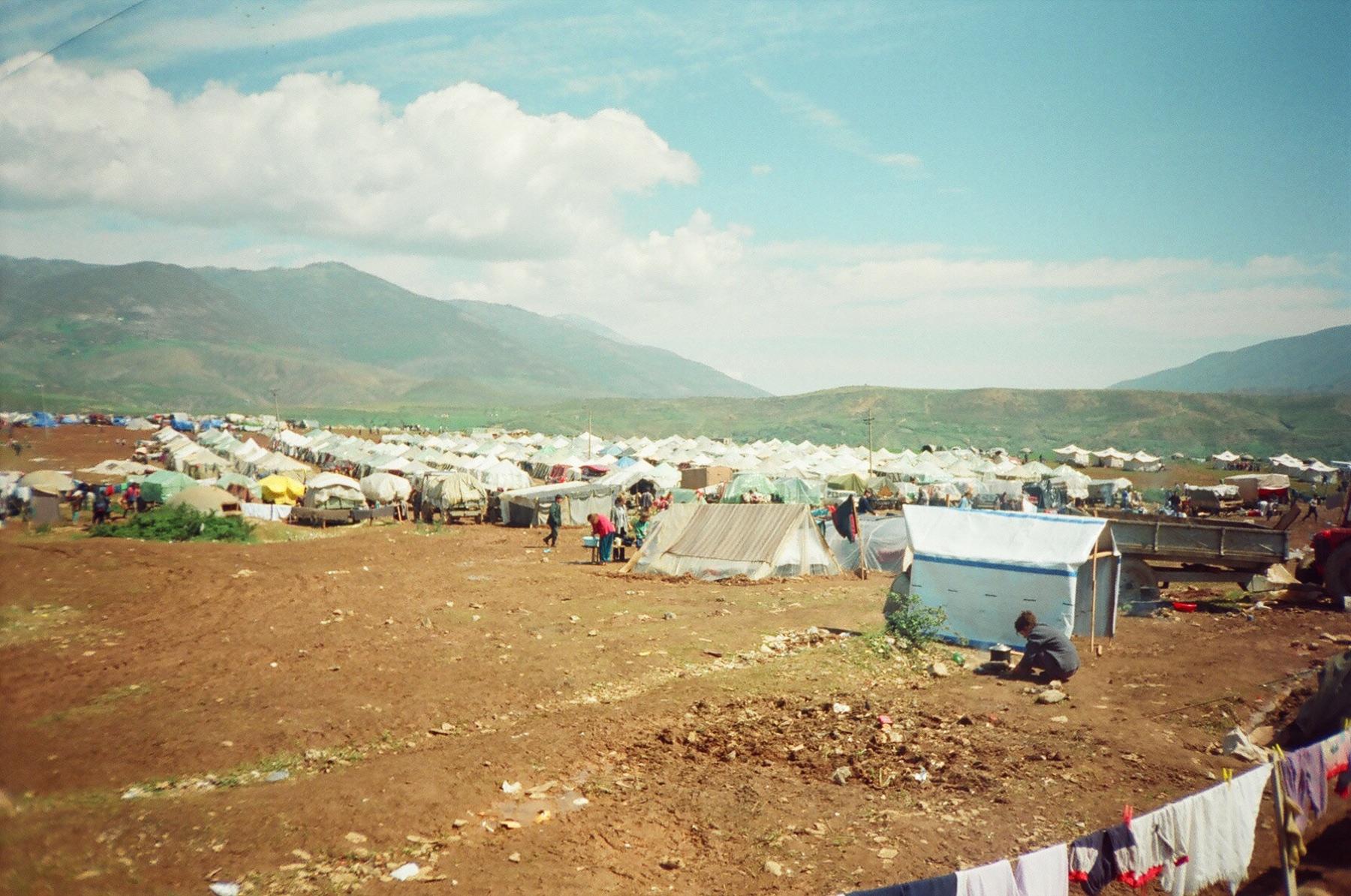
In the same case, the ICTY found that at least 700,000 Kosovo Albanians were displaced or expelled; by UNHCR's count, about 863,000 refugees were outside Kosovo by 9 June 1999. The main routes led to Kukës in Albania via the Morinë crossing, to Bllacë in Macedonia, and to Montenegro. At the border many refugees had their identity documents and licence plates taken from them — a practice documented by the OSCE and Human Rights Watch.[12][1][13]
These weeks saw some of the gravest crimes of the war, documented by human-rights organizations and in many cases examined by the ICTY: the killings in Bellacërkë and Krushë, the killing of members of the Berisha family in Suharekë, and the killings in Izbicë, Gjakovë, Mejë and Qyshk. In Podujevë on 28 March, members of the “Scorpions” paramilitary unit killed women and children from the Bogujevci and Duriqi families; trials for this crime were held in Serbia.[12][14][13]
Among the victims were public figures of the peaceful resistance. The human-rights lawyer Bajram Kelmendi and his two sons were taken from their home in Prishtina on the night of 24–25 March and found dead on 26 March. Fehmi Agani, a sociologist and LDK leader, was last seen alive on 6 May 1999 and was later found killed. In May 1999, after NATO air strikes on Dubrava prison, Albanian prisoners were killed; the number of victims and the exact circumstances remain disputed.[13]
The KLA during the bombing
During the air campaign the KLA kept fighting in very difficult conditions, while Serbian and Yugoslav forces carried out operations against its areas and against the civilian population. In some areas KLA units protected displaced civilians and helped them move; heavy fighting took place on the border with Albania, including the battle of Koshare.[15][4]
In the same period, according to charges brought before the Kosovo Specialist Chambers, individual KLA members detained and mistreated people at sites such as Zllash and the Kukës Metal Factory. The exact procedural status of these cases — Mustafa and Shala — is given in the justice section. As in every other case, these proceedings concern individual responsibility.[16][17]
Kumanovo, Resolution 1244 and KFOR
On 3 June 1999 the Yugoslav leadership accepted the peace plan presented by Finnish President Martti Ahtisaari, on behalf of the European Union, and Russian envoy Viktor Chernomyrdin. On 9 June the Military Technical Agreement on the withdrawal of Yugoslav and Serbian forces was signed in Kumanovo. On 10 June NATO suspended the bombing and the Security Council adopted Resolution 1244, which placed Kosovo under interim international administration and authorized an international security presence.[18][19][7]
On 12 June KFOR troops entered Kosovo, and on 20 June the withdrawal of Serbian and Yugoslav forces was completed. Hundreds of thousands of refugees returned within weeks. The KLA's Undertaking of Demilitarisation and Transformation, dated 20 June 1999, was signed in the early hours of 21 June; the process was completed in September 1999, when some of its members moved into the Kosovo Protection Corps, a civilian emergency organization established by UNMIK regulation.[20][21][22]
Notes on the evidence
- The Yugoslav authorities disputed the Verification Mission's and Human Rights Watch's documentation of Reçak. There is no judgment on Reçak, because the trial of Slobodan Milošević ended without a verdict.
- Displacement figures for 1999 vary with date and definition: the ICTY found “at least 700,000” displaced or expelled, while UNHCR counted about 863,000 refugees outside Kosovo by 9 June 1999.
- Civilian casualties of the NATO bombing have been estimated differently by Human Rights Watch, the Yugoslav authorities and other researchers; the number killed at Dubrava prison remains disputed.
- The debate over the Rambouillet military annex and its role in the Yugoslav refusal is a matter of historical interpretation.
Bibliography
Primary sources
- Human Rights Watch. Human Rights Watch investigation finds: Yugoslav Forces Guilty of War Crimes in Racak, Kosovo. 1999-01-29. https://www.hrw.org/news/1999/01/29/human-rights-watch-investigation-findsyugoslav-forces-guilty-war-crimes-racak-kosovo. Accessed 2026-09-16.
HRW's statement on its investigation in Reçak: it refers to the killing of 45 Albanian civilians, at least 23 people summarily executed on the hill without resistance, and others killed inside the village, including nine KLA soldiers.
Press statement
- OSBE — Zyra për Institucione Demokratike dhe të Drejta të Njeriut (ODIHR). Kosovo/Kosova: As Seen, As Told: An analysis of the human rights findings of the OSCE Kosovo Verification Mission, October 1998 to June 1999. 1999. https://www.osce.org/files/f/documents/d/d/17772.pdf. Accessed 2026-09-16.
An intergovernmental report. After 20 March it relies on refugee statements taken outside Kosovo, so the experiences of internally displaced people and areas with few refugees are under-represented.
Human-rights report
- Departamenti i Shtetit i SHBA-së (faqja arkivore 1997–2001). Rambouillet Agreement: Interim Agreement for Peace and Self-Government in Kosovo. https://1997-2001.state.gov/regions/eur/ksvo_rambouillet_text.html. Accessed 2026-09-16.
A copy hosted by a participating government; it carries no date, signature block or indication of which parties signed.
Diplomatic document
- NATO. Kosovo Air Campaign (March–June 1999): Operation Allied Force. 2024-10-21. https://www.nato.int/en/what-we-do/operations-and-missions/kosovo-air-campaign-march-june-1999. Accessed 2026-09-16.
An institutional self-account by a belligerent: it emphasises the humanitarian rationale and the absence of Allied fatalities, and gives no figures on civilian casualties of the bombing or the debate over legal authorisation.
Institutional report
- Fred Abrahams, Benjamin Ward. Under Orders: War Crimes in Kosovo. 2001-10-26. https://www.hrw.org/reports/2001/kosovo/. Accessed 2026-09-16.
An international human rights organisation working from field interviews. The report itself warns that the killings it documents (3,453) are a floor, not an estimate.
Human-rights report
- Tribunali Penal Ndërkombëtar për ish-Jugosllavinë (ICTY), faqja arkivore e mbajtur nga IRMCT. Prosecutor v. Slobodan Milošević (IT-02-54) — faqja e çështjes. IT-02-54. https://www.icty.org/en/case/slobodan_milosevic. Accessed 2026-09-16.
Indictments are prosecution allegations, not judicial findings.
Court record
- Tribunali Penal Ndërkombëtar për ish-Jugosllavinë (ICTY). Prosecutor v. Šainović et al. (IT-05-87) — faqja e çështjes (gjykimi: Milutinović et al.). IT-05-87. https://www.icty.org/en/case/milutinovic. Accessed 2026-09-16.
The official page of the case against six senior political, military and police officials for crimes in Kosovo in 1999, with the trial judgment (26 February 2009) and the appeal judgment (23 January 2014).
Court record
- Tribunali Penal Ndërkombëtar për ish-Jugosllavinë (ICTY). Prosecutor v. Vlastimir Đorđević (IT-05-87/1) — faqja e çështjes. IT-05-87/1. https://www.icty.org/en/case/djordjevic. Accessed 2026-09-16.
The official page of the case against Serbia's Assistant Minister of Internal Affairs, including findings on the concealment of bodies at Batajnica, Petrovo Selo and Lake Perućac.
Court record
- Dhomat e Specializuara të Kosovës dhe Zyra e Prokurorit të Specializuar. Specialist Prosecutor v. Salih Mustafa (KSC-BC-2020-05) — faqja e çështjes. KSC-BC-2020-05. https://www.scp-ks.org/en/cases/salih-mustafa. Accessed 2026-09-16.
The official case page concerning the Zllash detention compound (April 1999), with judgments, appeal decisions and the reparation order.
Court record
- Dhomat e Specializuara të Kosovës dhe Zyra e Prokurorit të Specializuar. Specialist Prosecutor v. Pjetër Shala (KSC-BC-2020-04) — faqja e çështjes. KSC-BC-2020-04. https://www.scp-ks.org/en/cases/pjeter-shala. Accessed 2026-09-16.
The official case page concerning the Kukës Metal Factory (May–June 1999), with judgments and subsequent decisions.
Court record
- Human Rights Watch. Civilian Deaths in the NATO Air Campaign. 2000-02. https://www.hrw.org/reports/2000/nato/.
HRW's report on incidents causing civilian deaths during NATO's 1999 air campaign against the FRY.
Human-rights report
- Tribunali Penal Ndërkombëtar për ish-Jugosllavinë (ICTY), Zyra e Prokurorit. Final Report to the Prosecutor by the Committee Established to Review the NATO Bombing Campaign Against the Federal Republic of Yugoslavia. 2000-06.
The report of the committee set up by the ICTY Prosecutor to review NATO's bombing campaign; it recommended that no investigation be opened.
Court recordAwaiting verification
- NATO/KFOR dhe qeveritë e RFJ-së e të Serbisë (qarkulluar si dokument i OKB-së S/1999/682). Military Technical Agreement between the International Security Force (KFOR) and the Governments of the Federal Republic of Yugoslavia and the Republic of Serbia. 1999-06-09. S/1999/682. https://docs.un.org/en/S/1999/682. Accessed 2026-09-16.
The agreement setting out the phased, verifiable withdrawal of all FRY forces from Kosovo within 11 days and the terms of KFOR's deployment. Signed by Lt Gen Mike Jackson (KFOR), Col Gen Svetozar Marjanović (VJ General Staff) and Lt Gen Obrad Stevanović (Serbian Ministry of Internal Affairs).
Military agreement
- Këshilli i Sigurimit i OKB-së. Security Council Resolution 1244 (1999). 1999-06-10. S/RES/1244 (1999). https://docs.un.org/en/S/RES/1244(1999). Accessed 2026-09-16.
Adopted at the 4011th meeting on 10 June 1999: it establishes international civil (UNMIK) and security (KFOR) presences under UN auspices, provides for “substantial autonomy within the Federal Republic of Yugoslavia” during the interim period, and for the demilitarisation of the KLA.
UN document
- UÇK dhe KFOR (teksti publikuar nga NATO; kopje në UN Peacemaker). Undertaking of Demilitarisation and Transformation by the UCK. 1999-06-20. https://peacemaker.un.org/sites/default/files/document/files/2024/05/990620undertaking20of20demilitarization20and20transformation20by20the20uck.pdf. Accessed 2026-09-16.
The KLA's unilateral undertaking to a ceasefire, disengagement from conflict zones, demilitarisation within 90 days and reintegration into civilian life, under KFOR supervision.
Diplomatic document
- UNMIK — Përfaqësuesi Special i Sekretarit të Përgjithshëm. UNMIK Regulation No. 1999/8 on the Establishment of the Kosovo Protection Corps. 1999-09-20. UNMIK/REG/1999/8. https://unmik.unmissions.org/sites/default/files/regulations/02english/E1999regs/RE1999_08.htm. Accessed 2026-09-16.
The regulation establishing the Kosovo Protection Corps as a civilian emergency service agency with no law-enforcement role, with up to 3,000 active and 2,000 reserve members, at least ten per cent from minority communities.
UN document
- Misioni i OSBE-së në Kosovë (OMIK). Kosovo/Kosova: As Seen, As Told — Part II: Human Rights in Kosovo, 14 June – 31 October 1999. 1999-11-05. https://omik.osce.org/kosovo/17781. Accessed 2026-09-16.
A field-mission report under the UNMIK framework, focused on postwar violence. It should be read together with Volume I.
Human-rights report
Scholarship and secondary literature
- Tim Judah. Kosovo: War and Revenge. Yale University Press, 2000. https://books.google.com/books/about/Kosovo.html?id=TDmwQgAACAAJ. Accessed 2026-09-16.
An author with extensive field reporting experience; the book's contents were not inspected when the record was verified.
Academic monograph
- Ivo H. Daalder, Michael E. O’Hanlon. Winning Ugly: NATO's War to Save Kosovo. Brookings Institution Press, 2001-10-01. https://www.brookings.edu/books/winning-ugly/. Accessed 2026-09-16.
Authors from a US think tank, focused on Western decision-making; Daalder later served as US Ambassador to NATO.
Academic monograph
- David L. Phillips. Liberating Kosovo: Coercive Diplomacy and U.S. Intervention. The MIT Press, 2012-07-20. https://doi.org/10.7551/mitpress/9590.001.0001. Accessed 2026-09-16.
The author took part in the diplomatic process; a US-policy-centred account.
Academic monograph
- Independent International Commission on Kosovo. The Kosovo Report: Conflict, International Response, Lessons Learned. Oxford University Press, 2000-10-19. https://doi.org/10.1093/0199243093.001.0001. Accessed 2026-09-16.
The same report as “oup-book-26245”; a second record for citations referring to the Commission as author.
Institutional report
- James Pettifer. The Kosova Liberation Army: Underground War to Balkan Insurgency, 1948–2001. Hurst Publishers, Londër, 2014-01. https://hurstpublishers.com/book/the-kosova-liberation-army-2/. Accessed 2026-09-16.
Reviews quoted by the publisher call it “sympathetic to the Kosovar cause” and written largely from the insurgents' perspective. The author knew many of the leaders personally.
Academic monograph
Notes
- [1]OSBE — Zyra për Institucione Demokratike dhe të Drejta të Njeriut (ODIHR). Kosovo/Kosova: As Seen, As Told: An analysis of the human rights findings of the OSCE Kosovo Verification Mission, October 1998 to June 1999. 1999. https://www.osce.org/files/f/documents/d/d/17772.pdf. Accessed 2026-09-16.
- [2]Human Rights Watch. Human Rights Watch investigation finds: Yugoslav Forces Guilty of War Crimes in Racak, Kosovo. 1999-01-29. https://www.hrw.org/news/1999/01/29/human-rights-watch-investigation-findsyugoslav-forces-guilty-war-crimes-racak-kosovo. Accessed 2026-09-16.
- [3]Tribunali Penal Ndërkombëtar për ish-Jugosllavinë (ICTY), faqja arkivore e mbajtur nga IRMCT. Prosecutor v. Slobodan Milošević (IT-02-54) — faqja e çështjes. IT-02-54. https://www.icty.org/en/case/slobodan_milosevic. Accessed 2026-09-16.
- [4]Tim Judah. Kosovo: War and Revenge. Yale University Press, 2000. https://books.google.com/books/about/Kosovo.html?id=TDmwQgAACAAJ. Accessed 2026-09-16.
- [5]Departamenti i Shtetit i SHBA-së (faqja arkivore 1997–2001). Rambouillet Agreement: Interim Agreement for Peace and Self-Government in Kosovo. https://1997-2001.state.gov/regions/eur/ksvo_rambouillet_text.html. Accessed 2026-09-16.
- [6]David L. Phillips. Liberating Kosovo: Coercive Diplomacy and U.S. Intervention. The MIT Press, 2012-07-20. https://doi.org/10.7551/mitpress/9590.001.0001. Accessed 2026-09-16.
- [7]Ivo H. Daalder, Michael E. O’Hanlon. Winning Ugly: NATO's War to Save Kosovo. Brookings Institution Press, 2001-10-01. https://www.brookings.edu/books/winning-ugly/. Accessed 2026-09-16.
- [8]Independent International Commission on Kosovo. The Kosovo Report: Conflict, International Response, Lessons Learned. Oxford University Press, 2000-10-19. https://doi.org/10.1093/0199243093.001.0001. Accessed 2026-09-16.
- [9]NATO. Kosovo Air Campaign (March–June 1999): Operation Allied Force. 2024-10-21. https://www.nato.int/en/what-we-do/operations-and-missions/kosovo-air-campaign-march-june-1999. Accessed 2026-09-16.
- [10]Human Rights Watch. Civilian Deaths in the NATO Air Campaign. 2000-02. https://www.hrw.org/reports/2000/nato/.
- [11]Tribunali Penal Ndërkombëtar për ish-Jugosllavinë (ICTY), Zyra e Prokurorit. Final Report to the Prosecutor by the Committee Established to Review the NATO Bombing Campaign Against the Federal Republic of Yugoslavia. 2000-06.· Awaiting verification
- [12]Tribunali Penal Ndërkombëtar për ish-Jugosllavinë (ICTY). Prosecutor v. Šainović et al. (IT-05-87) — faqja e çështjes (gjykimi: Milutinović et al.). IT-05-87. https://www.icty.org/en/case/milutinovic. Accessed 2026-09-16.
- [13]Fred Abrahams, Benjamin Ward. Under Orders: War Crimes in Kosovo. 2001-10-26. https://www.hrw.org/reports/2001/kosovo/. Accessed 2026-09-16.
- [14]Tribunali Penal Ndërkombëtar për ish-Jugosllavinë (ICTY). Prosecutor v. Vlastimir Đorđević (IT-05-87/1) — faqja e çështjes. IT-05-87/1. https://www.icty.org/en/case/djordjevic. Accessed 2026-09-16.
- [15]James Pettifer. The Kosova Liberation Army: Underground War to Balkan Insurgency, 1948–2001. Hurst Publishers, Londër, 2014-01. https://hurstpublishers.com/book/the-kosova-liberation-army-2/. Accessed 2026-09-16.
- [16]Dhomat e Specializuara të Kosovës dhe Zyra e Prokurorit të Specializuar. Specialist Prosecutor v. Salih Mustafa (KSC-BC-2020-05) — faqja e çështjes. KSC-BC-2020-05. https://www.scp-ks.org/en/cases/salih-mustafa. Accessed 2026-09-16.
- [17]Dhomat e Specializuara të Kosovës dhe Zyra e Prokurorit të Specializuar. Specialist Prosecutor v. Pjetër Shala (KSC-BC-2020-04) — faqja e çështjes. KSC-BC-2020-04. https://www.scp-ks.org/en/cases/pjeter-shala. Accessed 2026-09-16.
- [18]NATO/KFOR dhe qeveritë e RFJ-së e të Serbisë (qarkulluar si dokument i OKB-së S/1999/682). Military Technical Agreement between the International Security Force (KFOR) and the Governments of the Federal Republic of Yugoslavia and the Republic of Serbia. 1999-06-09. S/1999/682. https://docs.un.org/en/S/1999/682. Accessed 2026-09-16.
- [19]Këshilli i Sigurimit i OKB-së. Security Council Resolution 1244 (1999). 1999-06-10. S/RES/1244 (1999). https://docs.un.org/en/S/RES/1244(1999). Accessed 2026-09-16.
- [20]UÇK dhe KFOR (teksti publikuar nga NATO; kopje në UN Peacemaker). Undertaking of Demilitarisation and Transformation by the UCK. 1999-06-20. https://peacemaker.un.org/sites/default/files/document/files/2024/05/990620undertaking20of20demilitarization20and20transformation20by20the20uck.pdf. Accessed 2026-09-16.
- [21]UNMIK — Përfaqësuesi Special i Sekretarit të Përgjithshëm. UNMIK Regulation No. 1999/8 on the Establishment of the Kosovo Protection Corps. 1999-09-20. UNMIK/REG/1999/8. https://unmik.unmissions.org/sites/default/files/regulations/02english/E1999regs/RE1999_08.htm. Accessed 2026-09-16.
- [22]Misioni i OSBE-së në Kosovë (OMIK). Kosovo/Kosova: As Seen, As Told — Part II: Human Rights in Kosovo, 14 June – 31 October 1999. 1999-11-05. https://omik.osce.org/kosovo/17781. Accessed 2026-09-16.
Last reviewed:
Report an inaccuracy