
Editorial status: Awaiting verificationDrafted from the cited sources; not yet fully reviewed by the editors.
Contents (8)
In this chapter
- UNMIK and KFOR
- Violence after June 1999
- The missing and mass graves
- March 2004
- Independence and justice
- Memory and legacy
Key dates
- KFOR enters Kosovo; UNMIK administration begins
- Killing of Serb farmers in Gracko e Vjetër
- KLA demilitarization completed; Kosovo Protection Corps established
- Mass graves at Batajnica made public
- The March 2004 riots
- Declaration of independence
- Advisory opinion of the International Court of Justice
- Law on the Specialist Chambers adopted
Return and international administration
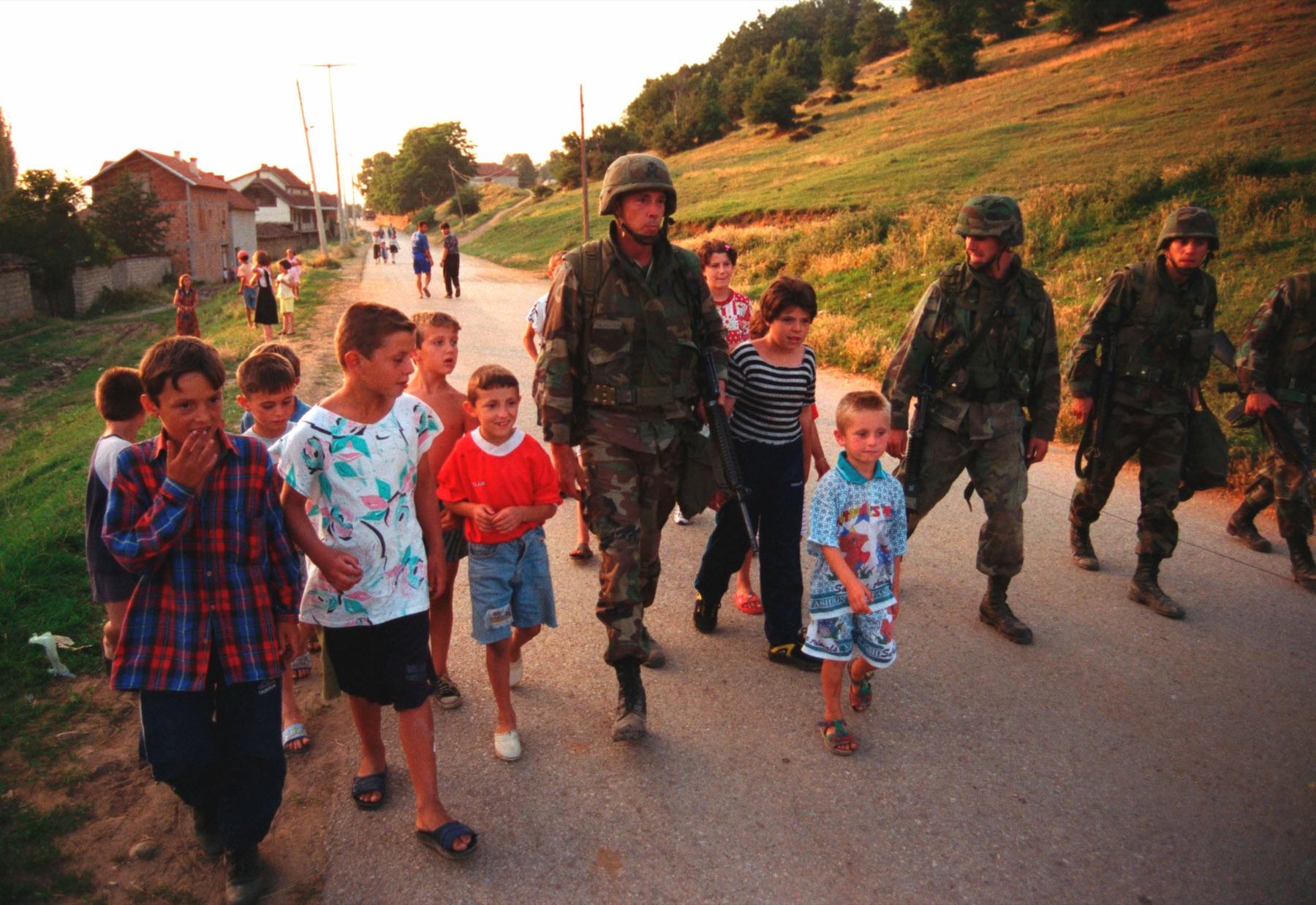
In the summer of 1999 most Albanian refugees returned within a few weeks, often to burned or destroyed homes. Under Resolution 1244, Kosovo was placed under the administration of the United Nations Interim Administration Mission in Kosovo (UNMIK), while security was entrusted to KFOR. Kosovo formally remained part of the Federal Republic of Yugoslavia, but Belgrade's institutions no longer controlled most of its territory.[1][2]
The Albanian parallel structures and those that emerged from the KLA were gradually absorbed into new institutions under international supervision. In the north, especially in Mitrovica, the Ibër river became a dividing line between Albanian-majority and Serb-majority areas — a division that remained a source of tension for years.[2][3]
Violence after June 1999
After Serbian and Yugoslav forces withdrew, Serbs, Roma, Ashkali, Egyptians, Bosniaks and Albanians perceived as collaborators became targets of killings, abductions, expulsions and arson. The second volume of the OSCE's report, covering June to October 1999, documented these abuses in detail. Large numbers of Serbs, Roma and members of other communities left Kosovo; estimates vary by source and method.[2]
On 23 July 1999, in Gracko e Vjetër (Staro Gracko) near Lipjan, fourteen Serb farmers were killed while harvesting wheat. The perpetrators have not been identified, and many crimes of this period remain unsolved. This archive records them as crimes committed after June 1999, separates them from wartime events and — as with every crime — attributes responsibility only to persons or structures identified by the evidence, never to a people.[2]
The missing and mass graves
After the war, thousands of families began searching for missing relatives. In May 2001 the mass graves at Batajnica near Belgrade became public; exhumations there and at other sites in Serbia continued through 2001–2002, recovering the remains of Albanians killed in Kosovo and secretly transported across the border. In Đorđević, the ICTY found that this was part of an organized operation to conceal crimes.[4]
According to the Humanitarian Law Center's 2015 report, the Kosovo Memory Book recorded by name 13,535 people killed or missing in connection with the war between 1 January 1998 and 31 December 2000: Albanians, Serbs, Roma, Bosniaks and others, civilians as well as members of armed formations. The database's methodology was evaluated by the Human Rights Data Analysis Group. The number of people still missing changes over time and is always cited with its source and date, as explained in the related analysis.[5][6]
March 2004
On 17 and 18 March 2004, after reports that several Albanian children had drowned in the Ibër river and after other incidents, riots broke out across Kosovo. Crowds attacked Serb communities, Orthodox churches and monasteries, and Ashkali homes. According to the United Nations and Human Rights Watch, 19 people were killed, hundreds were injured and thousands were displaced. UNMIK and KFOR were criticized for failing to protect the communities.
The violence of March 2004 revealed the fragility of the peace and badly damaged inter-ethnic trust. The archive has not yet registered primary sources for this period; the section will be completed with reports by international institutions and the relevant court records.
Independence and justice
On 17 February 2008 the Assembly of Kosovo declared independence. Serbia did not recognize it, while many states recognized Kosovo in the following years. In 2010 the International Court of Justice issued an advisory opinion finding that the declaration of independence did not violate international law.
Justice for war crimes remained partial. The ICTY tried senior Serbian and Yugoslav officials and several former KLA members; courts in Kosovo, with local and international judges, and courts in Serbia held other trials. In 2015 the Assembly of Kosovo adopted the law establishing the Kosovo Specialist Chambers, seated in The Hague, to try allegations of crimes committed between 1998 and 2000. Proceedings against former KLA leaders and members take place before these Chambers; the exact and current status of each case, including Thaçi et al., is given only on the court-case pages.[7]
For many Albanians, proceedings before the Specialist Chambers are a sensitive matter that touches the memory of the liberation war; for victims of the alleged crimes, they are a path to justice. This archive's principle remains the same: a judgment concerning individuals is not automatically a judgment against a people, a war, or every member of an organization.
Memory and legacy
The memory of the war is present throughout Kosovo: at the Memorial Complex in Prekaz, in martyrs' cemeteries, at memorials on massacre sites, and at the “Heroinat” memorial in Prishtina, dedicated to women during the war. Outside the Assembly of Kosovo, photographs of the missing are a reminder that for many families the war has still not ended.
The KLA's political legacy is part of public life, from political parties and veterans' organizations to debates about how this history should be taught in schools. This archive aims to serve that memory through sources — recognizing sacrifice, documenting the suffering of all victims, and marking clearly the points at which history remains open.
Notes on the evidence
- Many crimes committed after June 1999 against Serbs, Roma and others remain without identified perpetrators; their documentation is incomplete.
- The figure of 13,535 comes from the HLC's 2015 report and a specific definition (killed and missing in connection with the war, 1 January 1998 – 31 December 2000); later HLC publications may give updated figures.
- The sections on March 2004 and on the International Court of Justice's advisory opinion do not yet have sources registered in the archive and require editorial completion.
- Public assessment of the proceedings before the Specialist Chambers is polarized; the procedural status of each case should be read only on the court-case pages.
Bibliography
Primary sources
- Këshilli i Sigurimit i OKB-së. Security Council Resolution 1244 (1999). 1999-06-10. S/RES/1244 (1999). https://docs.un.org/en/S/RES/1244(1999). Accessed 2026-09-16.
Adopted at the 4011th meeting on 10 June 1999: it establishes international civil (UNMIK) and security (KFOR) presences under UN auspices, provides for “substantial autonomy within the Federal Republic of Yugoslavia” during the interim period, and for the demilitarisation of the KLA.
UN document
- Misioni i OSBE-së në Kosovë (OMIK). Kosovo/Kosova: As Seen, As Told — Part II: Human Rights in Kosovo, 14 June – 31 October 1999. 1999-11-05. https://omik.osce.org/kosovo/17781. Accessed 2026-09-16.
A field-mission report under the UNMIK framework, focused on postwar violence. It should be read together with Volume I.
Human-rights report
- Tribunali Penal Ndërkombëtar për ish-Jugosllavinë (ICTY). Prosecutor v. Vlastimir Đorđević (IT-05-87/1) — faqja e çështjes. IT-05-87/1. https://www.icty.org/en/case/djordjevic. Accessed 2026-09-16.
The official page of the case against Serbia's Assistant Minister of Internal Affairs, including findings on the concealment of bodies at Batajnica, Petrovo Selo and Lake Perućac.
Court record
- Fondi për të Drejtën Humanitare (HLC, Beograd) dhe Fondi për të Drejtën Humanitare Kosovë. Kosovo Memory Book. https://www.hlc-rdc.org/en/loss-database/kosovo-memory-book/. Accessed 2026-09-16.
A project by non-governmental organisations with a public methodology evaluated by HRDAG. Figures are updated over time; always cite them with date and version.
Database
- Dhomat e Specializuara të Kosovës dhe Zyra e Prokurorit të Specializuar. Specialist Prosecutor v. Hashim Thaçi et al. (KSC-BC-2020-06) — faqja e çështjes. KSC-BC-2020-06. https://www.scp-ks.org/en/cases/hashim-thaci-et-al. Accessed 2026-09-16.
The official page of the case against Hashim Thaçi, Kadri Veseli, Rexhep Selimi and Jakup Krasniqi. The trial judgment was pronounced on 16 September 2026; it is not final.
Court record
Scholarship and secondary literature
- Jule Krüger, Patrick Ball. Evaluation of the Database of the Kosovo Memory Book. 2014-12-10. https://hrdag.org/wp-content/uploads/2015/04/Evaluation_of_the_Database_KMB-2014.pdf. Accessed 2026-09-16.
Independent statistical experts, commissioned by the database owner. It evaluates enumeration completeness, not perpetrator responsibility.
Database evaluation
- Tim Judah. Kosovo: War and Revenge. Yale University Press, 2000. https://books.google.com/books/about/Kosovo.html?id=TDmwQgAACAAJ. Accessed 2026-09-16.
An author with extensive field reporting experience; the book's contents were not inspected when the record was verified.
Academic monograph
Notes
- [1]Këshilli i Sigurimit i OKB-së. Security Council Resolution 1244 (1999). 1999-06-10. S/RES/1244 (1999). https://docs.un.org/en/S/RES/1244(1999). Accessed 2026-09-16.
- [2]Misioni i OSBE-së në Kosovë (OMIK). Kosovo/Kosova: As Seen, As Told — Part II: Human Rights in Kosovo, 14 June – 31 October 1999. 1999-11-05. https://omik.osce.org/kosovo/17781. Accessed 2026-09-16.
- [3]Tim Judah. Kosovo: War and Revenge. Yale University Press, 2000. https://books.google.com/books/about/Kosovo.html?id=TDmwQgAACAAJ. Accessed 2026-09-16.
- [4]Tribunali Penal Ndërkombëtar për ish-Jugosllavinë (ICTY). Prosecutor v. Vlastimir Đorđević (IT-05-87/1) — faqja e çështjes. IT-05-87/1. https://www.icty.org/en/case/djordjevic. Accessed 2026-09-16.
- [5]Fondi për të Drejtën Humanitare (HLC, Beograd) dhe Fondi për të Drejtën Humanitare Kosovë. Kosovo Memory Book. https://www.hlc-rdc.org/en/loss-database/kosovo-memory-book/. Accessed 2026-09-16.
- [6]Jule Krüger, Patrick Ball. Evaluation of the Database of the Kosovo Memory Book. 2014-12-10. https://hrdag.org/wp-content/uploads/2015/04/Evaluation_of_the_Database_KMB-2014.pdf. Accessed 2026-09-16.
- [7]Dhomat e Specializuara të Kosovës dhe Zyra e Prokurorit të Specializuar. Specialist Prosecutor v. Hashim Thaçi et al. (KSC-BC-2020-06) — faqja e çështjes. KSC-BC-2020-06. https://www.scp-ks.org/en/cases/hashim-thaci-et-al. Accessed 2026-09-16.
Last reviewed:
Report an inaccuracy